This post details my journey with two pieces of software that I wanted to use for my Inquiry Project, and which one I ultimately decided to use.
Pressbooks
For my inquiry copyright project, I was first recommended to try Pressbooks, a self-publishing textbook site. I decided to create a test book that I planned to use to test various parts of Pressbooks as I learned more and progressed with the software. The test book itself did not need a substantial, quality piece of writing. Because of this, I used an old article I wrote for my old high school newspaper about the Netflix and Riot Games TV show, Arcane. This article was created with the intent to convince others to watch a show that was my favourite show of the year, so it’s far more opinionated than I plan to make my copyright project appear to be.
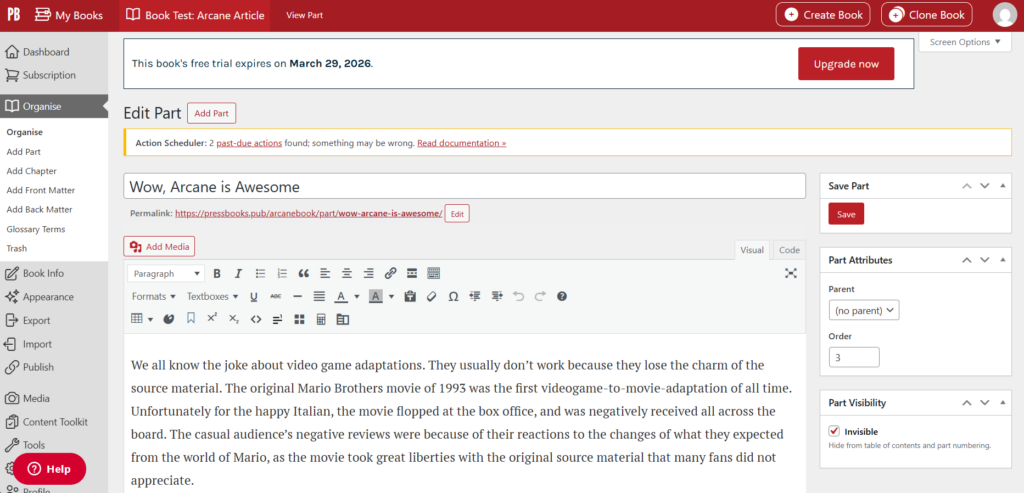
When I first opened the site, I felt a little overwhelmed. So many options and required steps in order to get it to look even semi-competent. Due to pressures outside of school, (at the original posting of this article) I was unable to add photos, as I have yet to find the correct procedure for citing photos of media when referenced in public articles. Thus, I focused more on how the text options and chapter section tools worked. However, once I had the text in, the tools and site format began to make more and more sense. In fact, it has a somewhat similar text-block format to the very same blog you are reading, which helped me get more comfortable with Pressbooks.
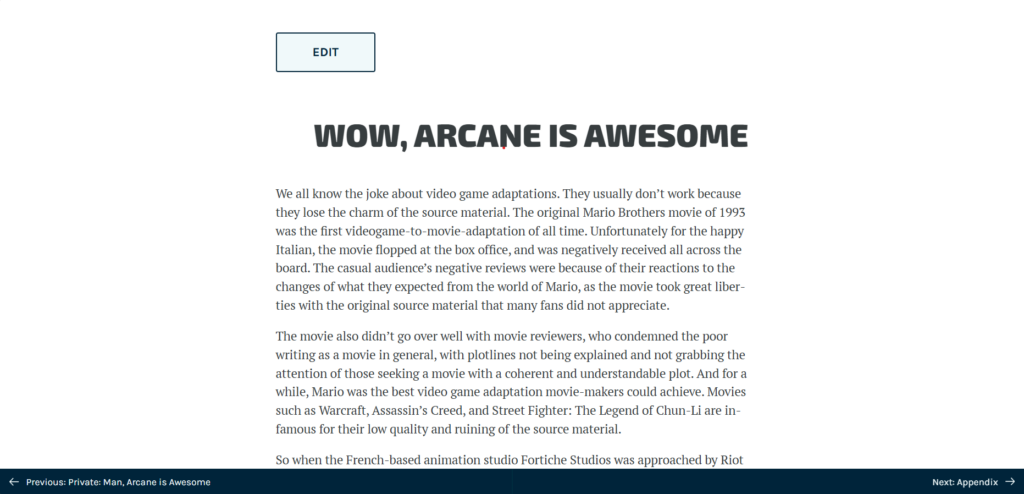
Here, I originally planned to have the public link to the Arcane test site. Pressbooks said that people were allowed to edit already published texts, so I thought I could add it here and update it alongside my copyright project in future Inquiry posts. My idea was to try out a tool or technique on the disposable Arcane site, and if I liked how it looked, I would copy it into the copyright article, which I would only update when I believed it would absolutely improve it.
Unfortunately, as I wrapped up the site to a standard that I felt comfortable enough to post as a proof-of-concept, I tried to post the site only to not be able to find it publically on a seperate device. I tried again and again, looked up Pressbook’s official guide, and it just did not seem to work. Pressbooks runs on a 12 dollars a month subscription plan in order to keep editing access, which means that if I were to commit to this software, it would be a financial commitment as well as a time one. As someone who is struggling to be able to even post my work, I do not believe that Pressbooks’ advantages balance out the worry and unease I feel when trying to make it work.
This meant I needed to find an alternative way to post my research on copyright.
Substack
While I was looking for more softwares that could work, I remembered the site Substack. A content creator that I personally enjoy watching and reading a lot is Sam Gaglio, popular online under the name “Rhystic Studies,” a Youtube channel where he analyzes different aspects of the card game Magic the Gathering. Most often this refers to the art and design process of the various expansions, using his writing skill to teach casual players of Magic the underlying ideas and themes of their favourite cards. While his most popular platform is Youtube, he also posts the scripts of his videos as articles in his own personal Substack.
The format was appealing to me, and having a content creator that I enjoy consistently using it gave me hope that it could be a worthwhile alternative choice of publication. Another thing that drew me to it was the lack of a price tag. Substack works similarly to a social media platform like Bluesky or Instagram Threads, where most of the posts are text-based, supported by images. It also allows for other profiles to essentially repost articles they find interesting, meaning that if I were to invest more time and effort into it past the end of my semester, there is the potential for my articles to generate growth and traction through word of mouth.
Here is a link to my test article on Substack. I found this software to be much easier to handle than Pressbooks, and I can definitely see myself using this in the future even past the end of my classes. The tools, while not as in depth as Pressbooks, were more than good enough to do what I needed to do for my test. I will definitely continue using Substack as my collection of my progress with copyright. The current idea is that with each Inquiry Progress post, I will also make a post on Substack that compiles my information so far.
I’m definitely looking forward to this project and whatever else I plan to use Substack for.